Digiday published a piece today that should be required reading for anyone who approves a marketing budget. The headline was about ad agencies — the big holding companies, the PMGs and Publicis of the world — wrestling with AI costs that are rising faster than anyone can demonstrate the value to justify them. Token caps. Output-based pricing debates. CFOs asking questions that nobody has clean answers to yet.
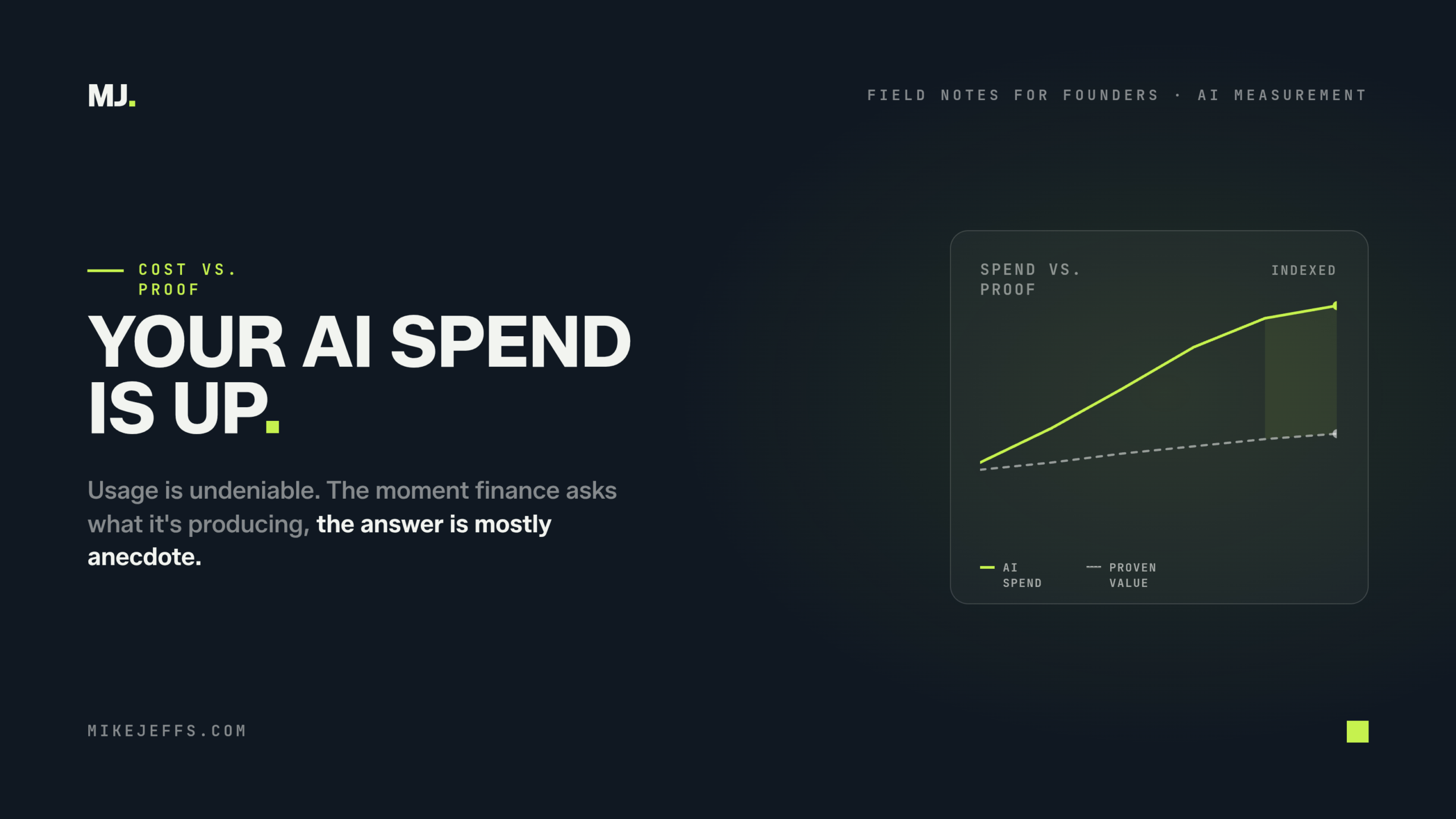
It’s a trade press story about enterprise agencies. But the underlying problem isn’t enterprise-specific, and it isn’t agency-specific. It’s showing up in marketing teams of every size, and the version of it that lands on a mid-market marketing director’s desk looks like this: the AI subscriptions are multiplying, the usage is undeniable, and when someone senior asks what it’s all producing, the answer is mostly anecdote.
That’s the conversation that’s coming, if it hasn’t arrived already. Here’s how to get ahead of it.
What’s Actually Happening
AI tool adoption in marketing has followed the same pattern as almost every significant technology shift before it. Fast, enthusiastic, relatively undisciplined in the early stages. Businesses bought licences, teams started using tools, and the productivity gains felt real enough that nobody pushed too hard on measurement.
That phase is ending.
As AI costs compound — more users, more models, more use cases, higher token volumes — the question of what it’s all worth becomes a finance question, not just a marketing one. And finance teams ask different questions to marketing teams. They want numbers, not narratives. They want to see the line between spend and outcome. “It makes us more efficient” doesn’t survive a quarterly budget review the way it survives a team standup.
The Digiday piece quotes an industry analyst saying the honeymoon around AI and agencies is essentially over. CMOs were promised cost efficiencies and speed to market, and the fee savings haven’t materialised in the way procurement teams expected. The same dynamic plays out inside businesses: leadership was sold on AI as a cost reducer, and what they’re actually seeing is a new category of cost that requires its own justification.
It’s worth noting this is only one layer of the cost story. The infrastructure running all of these tools — the data centres, the compute, the energy demands — carries its own compounding bill that most marketing teams never see. I’ve written about how the AI power grid problem is already beginning to affect enterprise tech stacks, and the pricing pressure from that will eventually land on the SaaS tools sitting on top of it.
The Measurement Problem Is Specific
The reason this is hard isn’t that AI doesn’t produce value. For most marketing teams using it seriously, it does. The reason it’s hard is that the value shows up in the wrong places for traditional measurement frameworks.
AI makes individual contributors faster. It compresses the time between brief and first draft, between data request and analysis, between campaign idea and execution plan. Those gains are real and they compound across a team over weeks and months. But they’re diffuse. They don’t show up cleanly in a single metric. They’re woven into the throughput of the whole function, which makes them easy to feel and hard to prove.
The second problem is attribution. If your pipeline is up, your content is performing better, and your campaigns are converting at a higher rate — how much of that is AI, and how much is the new messaging strategy, the improved targeting, the market conditions, or simply the team getting better at their jobs? Isolating AI’s contribution from everything else happening simultaneously is genuinely difficult, and anyone claiming to have solved it cleanly is probably oversimplifying.
This doesn’t mean measurement is impossible. It means you have to be more deliberate about it than most teams currently are.
What Good AI Measurement Actually Looks Like
The businesses that will answer the CFO’s question convincingly aren’t the ones with the most sophisticated attribution models. They’re the ones that defined what they were measuring before they started spending, not after.
That sounds obvious. It almost never happens.
Here’s the framework I’d use.
Separate the cost categories. AI spend in a marketing function typically falls into three buckets: productivity tools (writing assistants, image generation, research tools used by individuals), workflow automation (agents, integrations, automated campaign management), and strategic capability (market intelligence, predictive analytics, deeper data work). Each has a different cost profile and a different value case. Treating them as one line item makes measurement impossible and makes the conversation with finance harder than it needs to be.
Define a baseline before you add tools. How long does it currently take to produce a piece of long-form content? How many hours goes into a monthly performance report? How many campaigns does the team run per quarter? These baselines are the reference points against which efficiency gains become measurable. Without them, you’re estimating.
Track time displacement, not just time saved. Time saved is a metric that rarely survives scrutiny, because the time rarely disappears — it gets absorbed into other work. What matters is what that time was redirected towards. If the team is producing more content at the same headcount, that’s measurable. If the time freed by AI tools went into strategic work that directly influenced pipeline, that’s a story you can tell. If it went into meetings, it’s less compelling.
Connect AI activity to commercial outputs where the chain is short. The shorter the chain between AI tool and commercial outcome, the more defensible the ROI case. An AI tool that directly improves email conversion rates has a short chain — you can measure it. An AI tool that makes your content team feel more creative has a very long one. Both might be worth having, but only one survives a board-level budget conversation.
Build a total cost of ownership view, not just a subscription list. The licence cost of an AI tool is often the smallest part of what it actually costs. Integration work, training time, prompt engineering, governance, the occasional cleanup when something goes wrong — these are real costs that don’t appear on the invoice. A realistic TCO model for each significant AI investment gives you a more honest picture of what you’re actually spending and what the return needs to be.
The Governance Question for Smaller Teams
The Digiday piece describes PMG implementing a $50-a-day token cap per user after a period of essentially unlimited access. For a large agency, that’s a meaningful governance intervention. For a ten-person marketing team at an SME, the equivalent conversation looks different but the principle is the same.
Without some structure around who is using which tools for what purpose, AI spend in a marketing function tends to sprawl. Three people have individual ChatGPT subscriptions. Someone signed the team up for a content tool that duplicates functionality in the CRM. The head of demand gen is running a separate contract with an AI analytics platform that nobody else uses. The total monthly spend is probably fine, but nobody has a clear view of it, and when someone asks, it takes two weeks to pull together.
Governance doesn’t have to be complex. At a minimum it means: a central record of what’s been subscribed to and why, a named owner for each tool, a quarterly review of whether it’s still earning its place, and a clear process for evaluating new tools before someone signs up on a credit card.
That’s not bureaucracy. That’s being able to answer the question when it gets asked.
This is closely related to the broader AI agent governance question I covered in an earlier piece — the principle is the same whether you’re governing agent actions or tool subscriptions. Structure before scale, every time.
The Token Discipline Mindset
One of the more practical shifts in the Digiday piece is the move from unmetered exploration to what one exec called “token discipline” — being intentional about which tasks go to which models rather than defaulting to the most capable (and most expensive) tool for everything.
This is worth borrowing as a principle even if you’re not paying per token. The habit of asking “does this task actually need the most powerful tool available, or would something lighter and cheaper produce the same result?” is good practice regardless of your billing model. It forces clarity about what you’re using AI for and why, which is the foundation of any sensible measurement approach.
The marketers who are good at this treat AI models like they treat any other resource: you use what the task requires, you don’t over-specify, and you track whether you got what you paid for.
This mindset also connects to the wider conversation happening around where AI compute actually lives and who controls it. As on-premises and sovereign AI options mature, the cost-per-query conversation gets more complex — but the discipline of matching model to task remains the right starting point regardless of your infrastructure choices.
The Harder Question Behind the Numbers
There’s a more uncomfortable version of this conversation that most teams aren’t having yet, but will.
If AI tools are making your team more productive, and productivity is up, but headcount hasn’t changed — where is the value going? Is it going into more and better work that drives commercial outcomes? Or is it going into maintaining current output at lower effort, without any visible improvement in results?
Both are legitimate uses of productivity gains, but only one makes a compelling case for continued and increasing AI investment. And the answer requires being honest about whether the marketing function is using the time and capacity created by AI to do better work, or simply to do the same work more comfortably.
That’s not a measurement question. It’s a strategic one. And it’s the one that will determine whether AI spend in marketing is genuinely defensible over the next two years, or whether it becomes the next line item that procurement starts pushing back on.
For businesses thinking about how AI fits into their wider tech stack strategy — particularly the emerging tension between frontier models and sovereign alternatives — the frontier vs sovereign AI question adds another dimension to this cost and governance conversation that’s worth understanding before it becomes a decision you have to make under pressure.
The Short Version
The bill is coming due. Not dramatically, not all at once, but steadily and in ways that will require cleaner answers than most marketing teams currently have.
The businesses that get ahead of this aren’t the ones spending most or least on AI. They’re the ones that decided what they were trying to achieve before they started spending, built enough measurement discipline to know whether they’re achieving it, and can have the CFO conversation from a position of evidence rather than enthusiasm.
That conversation is worth having now, before someone else schedules it for you.