At some point, almost every marketing leader has sat in a meeting where someone — usually the CEO, sometimes a new hire, occasionally a well-meaning board member — says some version of the same thing: “I think we need a new website.”
It’s one of the most expensive sentences in business. Not because rebuilding is always wrong, but because the conversation that follows it almost never starts in the right place.
A website rebuild is a significant undertaking. Depending on your platform, your complexity, and who you work with, you’re looking at anywhere from £10,000 to £200,000 and six to eighteen months of organisational effort. Done well, it can meaningfully change your commercial results. Done for the wrong reasons, it produces a new-looking site with the same underlying problems — and a budget that’s gone.
So before you brief an agency, write a requirements document, or start a platform comparison, the question worth sitting with is a more honest one: do you actually need a rebuild, or do you need to fix what you have?
Why People Reach for a Rebuild Too Quickly
The rebuild instinct is understandable. Websites accumulate problems over time — technical debt, outdated design, pages that don’t reflect the current business, content that nobody has touched in three years. At a certain point, the site starts to feel more like a liability than an asset, and the temptation is to start fresh.
There’s also a less acknowledged driver: a rebuild feels like doing something. It’s visible, it’s exciting, it involves agencies and presentations and decisions. Fixing what you have is quieter, less glamorous, and harder to point to in a board update.
But visible activity is not the same as the right activity. And in my experience, a significant proportion of the websites that go through full rebuilds didn’t need one. They needed a clear-eyed audit, a prioritised list of fixes, and someone with enough authority to push them through.
The test is not how the site looks or feels to you internally. The test is whether it is actually preventing commercial outcomes — and whether those outcomes can be unlocked more cost-effectively without starting again.

The Case for Fixing What You Have
There are situations where fixing the existing site is clearly the right call.
Your platform is sound but the execution is poor. If you’re on WordPress, Webflow, or another capable platform and the site isn’t performing, the platform is rarely the problem. Content that isn’t optimised, a navigation structure that doesn’t reflect how buyers actually think, landing pages that haven’t been updated in two years, technical SEO issues that have never been addressed — these are all fixable without touching the platform.
Your SEO has authority you can’t afford to lose. A site that has been around for years, has accumulated backlinks, and ranks well for valuable terms carries equity that a rebuild can destroy if it’s not handled carefully. A redirect strategy can preserve most of it, but most doesn’t mean all, and the recovery period after a rebuild — even a well-managed one — is real. If organic search is a meaningful acquisition channel, the bar for a rebuild should be higher.
The problems are content and strategy, not technology. This is the one that most often goes undiagnosed. A site that isn’t converting isn’t necessarily a design problem or a technology problem — it’s often a clarity problem. The wrong messages, positioned for the wrong audience, structured around the business’s internal logic rather than the customer’s decision journey. A new design won’t fix that. Better thinking will.
You’re close to a significant business change. If a new product launch, a funding round, an acquisition, or a rebrand is on the horizon in the next twelve months, rebuilding now creates work you’ll redo. Fix the critical issues, hold the site stable, and rebuild at the point where the new direction is clear enough to build around.
You don’t have the internal resource to support a rebuild properly. A rebuild isn’t just an agency project. It requires significant input from your side — content, stakeholder reviews, approvals, testing. If your team is already stretched, a rebuild that’s under-resourced internally is a rebuild that runs late, goes over budget, and produces a result nobody is satisfied with.
The Case for a Rebuild
There are also situations where a rebuild is genuinely the right answer, and trying to fix a fundamentally broken foundation is false economy.
The platform can’t do what you need it to do. If you’ve outgrown your CMS (you need personalisation capabilities it can’t deliver, integrations it won’t support, performance it can’t achieve) you’ll keep hitting the ceiling. You can work around it for a while, but workarounds accumulate their own technical debt and their own costs. At some point the platform becomes the constraint on your marketing, not just an inconvenience.
The technical debt is structural, not cosmetic. Some sites are built on foundations that make every subsequent change expensive and risky. Plugin conflicts, custom code that nobody documented, themes so heavily modified that updates break things — if your developers are spending most of their time managing fragility rather than building value, the cost of maintaining the existing site may exceed the cost of starting again over a three-year horizon.
The site fundamentally misrepresents the business. If your positioning has changed significantly, your audience has shifted, or the business looks materially different from what the site communicates — and that gap is affecting commercial performance — a refresh isn’t enough. You can update content and imagery on an existing site, but if the underlying architecture was built around a different business, the seams show.
You’re expanding into new markets or channels. A site built for one geography, one language, or one product line often doesn’t scale well when the business needs it to do more. Sometimes you can extend; sometimes the original architecture makes that extension so painful that a rebuild with the right foundation is cheaper over time.
The brand has undergone a genuine transformation. Not a logo refresh or a colour palette update — those can usually be applied to an existing site. A fundamental repositioning, a merger or acquisition that creates a new entity, a move upmarket that requires an entirely different visual register. When the brand change is deep enough, the site needs to carry it properly.
How to Make the Decision Properly
The mistake most businesses make is starting with opinions — “I don’t like how it looks,” “it feels dated,” “our competitors’ sites are better” — rather than data. Opinions are valid signals, but they’re not a basis for a six-figure decision.
Here’s the process I’d recommend before committing to either path.
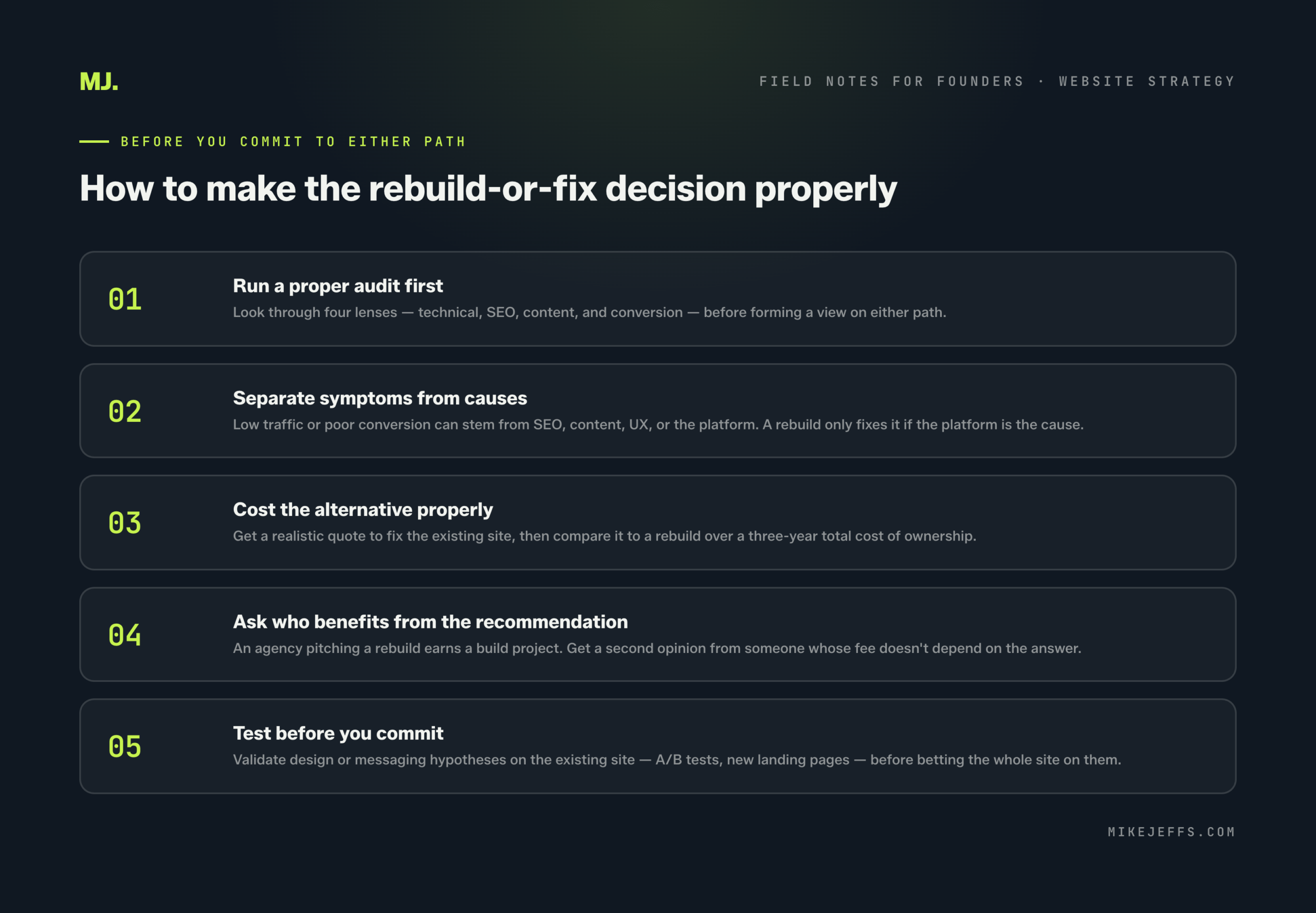
Run a proper audit first. Look at the site through four lenses: technical (speed, crawlability, mobile performance, Core Web Vitals), SEO (rankings, traffic, backlink profile, on-page optimisation), content (accuracy, relevance, clarity, coverage of the buyer journey), and conversion (where are people landing, what are they doing, where are they dropping off). Until you have a clear picture across all four, you’re guessing.
Separate symptoms from causes. Low traffic might be an SEO problem or a content problem or a technical problem or all three. Poor conversion might be a UX problem or a messaging problem or a trust problem. A rebuild addresses symptoms only if the cause is the platform or the fundamental architecture. If the cause is something else, the rebuild won’t fix it.
Cost the alternative properly. Get a realistic estimate of what fixing the existing site would cost — not a rough guess, a properly scoped piece of work. Then compare that to a rebuild quote over a three-year total cost of ownership horizon (platform, build, ongoing development, content migration). Sometimes the gap is smaller than people expect. Sometimes it’s larger. You need the actual numbers to make a rational decision.
Ask who benefits from the rebuild recommendation. This isn’t cynicism — it’s due diligence. An agency pitching you a rebuild earns a build project. A consultant who helps you fix the existing site earns a smaller engagement. The incentives are different, and they can influence the advice. Get a second opinion from someone whose recommendation doesn’t determine their invoice.
Test before you commit. If the question is whether a design or messaging change would improve conversion, test it on the existing site before rebuilding around the hypothesis. A/B testing, updated landing pages, new navigation — these can validate assumptions at low cost before you commit to a rebuild that bets the whole site on them.
To Rebuild or Fix?
Most businesses that think they need a website rebuild actually need three things: a clear articulation of what the site is supposed to do commercially, an audit that identifies what’s actually preventing that, and a prioritised plan to fix it.
Some of those fixes will be quick and inexpensive. Some will be significant projects. A small number will point to platform limitations that genuinely justify a rebuild. But that conclusion should come at the end of an honest diagnostic process, not at the beginning of one.
The businesses I’ve seen waste the most money on digital are the ones that rebuilt when they should have fixed, because a rebuild felt more decisive than the quieter work of getting the fundamentals right.
A new website is not a strategy. It’s an outcome of one. Get the strategy clear first, and the decision about whether to rebuild or fix usually answers itself.