For the past twenty years, the tech industry operated under a collective illusion: that the internet was weightless. Code lived in an ephemeral cloud, compute scaled with the click of a button, and the physical constraints of the real world felt entirely decoupled from software architecture.
The artificial intelligence boom has violently shattered that illusion.
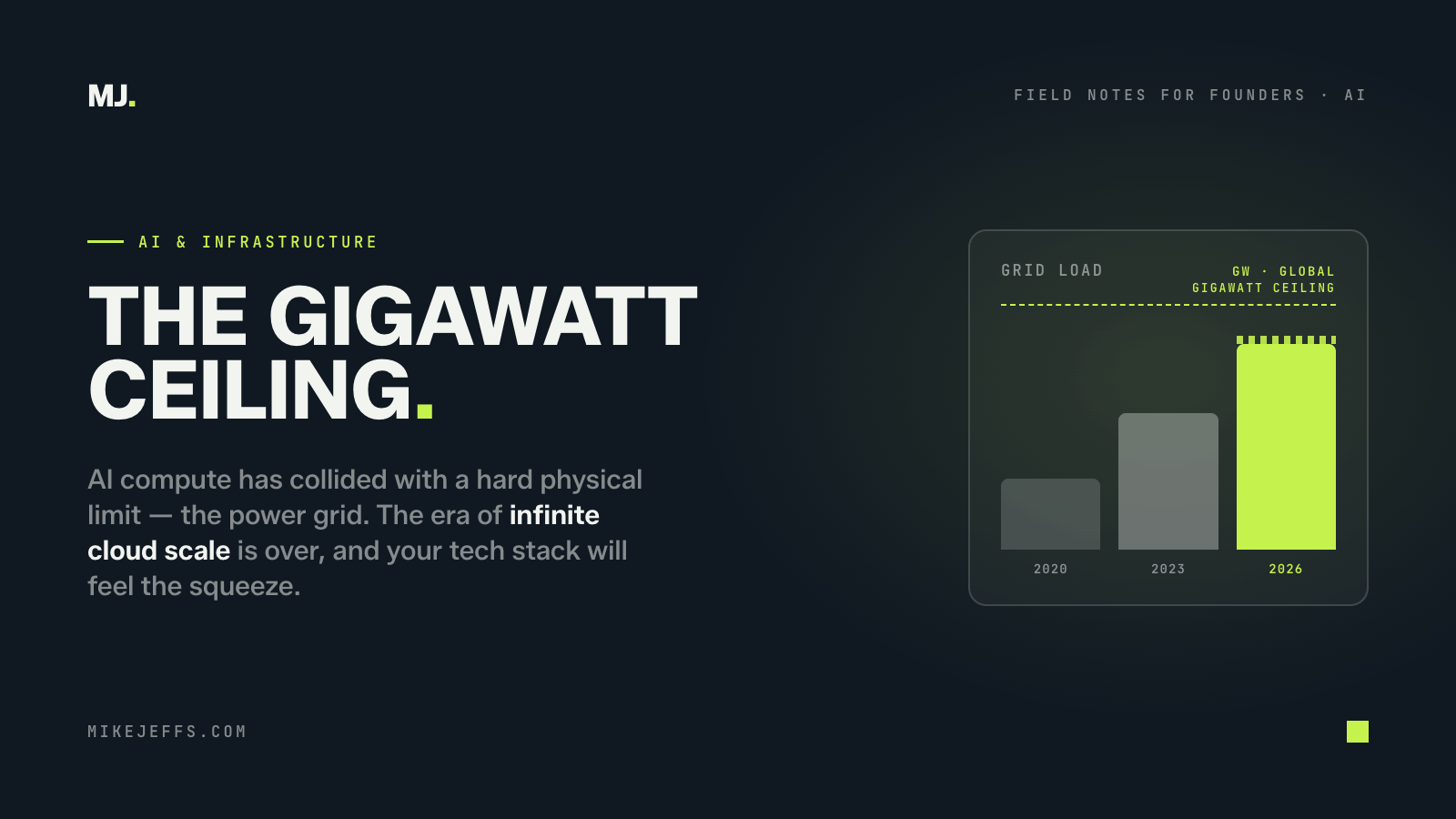
As hyperscalers inject hundreds of billions of dollars into AI data centres, Silicon Valley has collided with a hard physical limit: the capacity of our electrical grids. We have officially entered the era of The Gigawatt Ceiling. The sheer volume of power required to train and run next-generation frontier models is no longer just a line item on an environmental report, it is actively transforming into a bottleneck that will ripple down to affect your everyday tech stack.
The Reality of the AI Energy Drain
To understand why your software infrastructure is facing a looming speed bump, you have to look at the sheer physics of generative AI. A single, standard ChatGPT query consumes nearly ten times the electricity of a traditional Google search (roughly $2.9\Wh compared to $0.3\Wh}).
When you scale that maths across millions of enterprise users, legacy grids buckle. The total data centre energy load (encompassing server consumption and heavy-duty industrial cooling) has more than doubled since 2020, currently rocketing past 70 gigawatts globally. The International Energy Agency (IEA) projects that global data centre power demands will comfortably push past 1,000 Terawatt-hours – a number equivalent to the entire electricity consumption of Japan.
Average Energy Consumed per Query:
[Traditional Google Search]  ■ 0.3 Wh
[Generative AI Query]        ■■■■■■■■■■ 2.9 Wh (~10x increase)
Big Tech’s initial response was to buy up every scrap of renewable energy on the market. But wind and solar suffer from the fatal flaw of intermittency; AI clusters require uninterrupted, flawless “baseload” power 24/7/365. Consequently, emissions are spiking – Google reported a 48% increase against its 2019 baseline, and Microsoft saw a 29% surge since 2020.
The Nuclear Desperation Move
Because renewable grids can’t keep up, tech giants have turned to the ultimate dense energy source: nuclear power.
We are currently witnessing a massive tech-fueled nuclear renaissance:
- Microsoft signed a 20-year deal to resurrect the shuttered Three Mile Island nuclear plant (rebranded as the Crane Clean Energy Center).
- Amazon locked down 1.9 gigawatts of power directly from the Susquehanna nuclear plant in Pennsylvania.
- Google placed a world-first order for a fleet of six to seven small modular reactors (SMRs) from Kairos Power.
- Meta shattered records by announcing massive agreements with Vistra, TerraPower, and Sam Altman-backed Oklo to secure up to 6.6 gigawatts of nuclear capacity.
The Infrastructure Lag: While a brand-new AI data centre can be erected and filled with H100s or B200s in 12 to 18 months, planning, permitting, and building a new advanced nuclear reactor takes a decade.
This massive timeline mismatch is where the Gigawatt Ceiling forms. Big Tech is buying up the future power grid, but those gigawatts aren’t arriving tomorrow.
How the Grid Crisis Impacts Your Tech Stack
If you’re not building LLMs, it’s easy to assume this energy war doesn’t affect you. But if your enterprise stack relies on AWS, Azure, Google Cloud, or third-party SaaS tools built on top of them, you will feel the squeeze in three distinct ways:
1. The Cloud Computing Cap
For a decade, cloud compute was functionally infinite. If your dev team wrote inefficient code or spun up massive, unoptimized databases, you just paid a slightly higher bill. That era is ending. Hyperscalers can no longer infinitely scale their data centers because regional utilities are denying them new grid connections.
As a result, cloud providers will likely begin rationing or throttle availability for non-essential compute. High-performance computing tiers will face stricter quotas, and provisioning new cloud instances in popular regions will come with longer lead times.
2. The Compute Cost Creep
Simple supply and demand tells us that when a resource hits a hard physical ceiling, prices spike. Building new nuclear or natural gas plants to sustain AI data centers costs billions. Hyperscalers are not going to absorb those capital expenditures.
Expect to see “AI premiums” bake themselves into standard enterprise software. Even standard SaaS tools that integrate minor AI features will raise their baseline subscription costs to cover their soaring API call overhead.
3. Slower Cycle Innovation
When tech giants are forced to allocate their limited, precious gigawatts toward keeping their core foundation models alive, fewer resources will be dedicated to general cloud infrastructure updates, edge compute expansion, and standard database optimization. The rapid velocity of overall tech stack innovation will inevitably slow down as the industry spends its energy fighting a physical utility crisis.
The Path Forward: Pragmatic Efficiency
How should B2B strategists and technology leaders respond to the Gigawatt Ceiling?
The winning strategy for the back half of the 2020s shifts from unbridled scale to extreme architectural efficiency.
We are already seeing a massive trend toward “slimmer” tech. Models like China’s DeepSeek have proven that AI doesn’t always need to be hyper-compute-intensive to yield elite results. Moving forward, software engineering teams should prioritise algorithmic optimisation, rely on smaller, fine-tuned Small Language Models (SLMs) rather than brute-forcing massive LLMs, and embrace “on-device” inference (leveraging local laptop and smartphone superchips rather than calling the cloud for every single task).
Further Look into the Tech Grid Challenges
You can understand more about the intense physical scale of the data centres being built right now, check out this video which explains the mechanics behind Microsoft’s Three Mile Island deal.