For the past fifteen years, scaling a B2B SaaS footprint internationally was an infrastructure cakewalk. If your software stack worked seamlessly for your marketing, sales, or operations teams in London, you could deploy that exact same configuration to teams in Paris, Tokyo, or Dubai with minimal structural re-engineering. It was the era of the universal, global tech stack—one cloud, one platform, everywhere.
But the rapid evolution of artificial intelligence has shattered that global uniformity. We are entering the age of The Fractured Stack, driven by a massive, geopolitically charged shift toward technology independence.
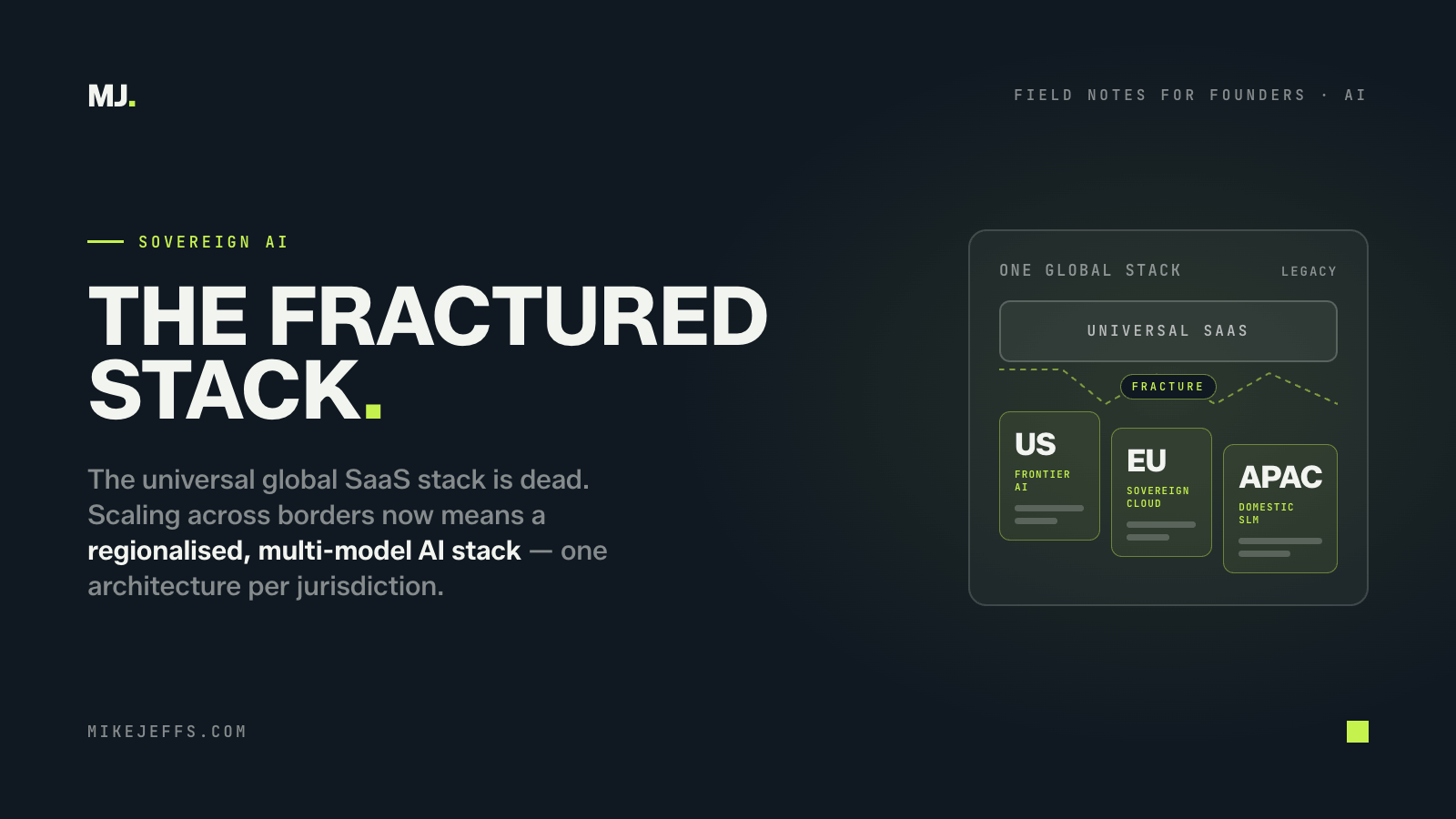
According to Gartner, worldwide sovereign cloud infrastructure spending is forecast to jump 35.6% to over $80 billion, triggering a structural migration of current enterprise workloads from global hyperscalers to regional and local cloud providers.
Nations are no longer content relying on a tiny handful of American big-tech companies hosted on foreign servers to supply their intelligence. Countries like France, Japan, India, and the UAE are pouring billions into building domestic, culturally aligned, and linguistically optimised language models housed within their own physical borders.
For B2B leaders, this means the one-size-fits-all SaaS model is officially dead. Expanding internationally now requires managing a regionalised, multi-model AI tech stack.
1. Cultural Logic and the Failure of Hyper-Generalization
Sovereignty isn’t just a dry legal debate about server locations; it is an operational question of contextual and cultural accuracy.
Mainstream frontier models are trained overwhelmingly on Western, English-centric datasets. Consequently, they reflect Western business conventions, linguistic structures, and societal perspectives. When a B2B enterprise tries to deploy these hyper-generalised models to handle autonomous sales communication, localisation, or customer service workflows in non-Western markets, they quickly run into a wall of algorithmic bias and practical inefficiency.
A generic Western model frequently misinterprets the nuances of local corporate law, regional tax structures, and cultural business etiquette.
The Rise of Regional AI Factories
To bridge this gap, global governments are funding domestic “AI Factories” – high-performance, regional data centers built in partnership with local telecoms and infrastructure providers (like France’s multi-billion-euro AION consortium or the UAE’s world-class Falcon model family).
These regional frameworks speak local languages natively, understand jurisdictional nuances, and align completely with national business identities. As a result, if you want to compete or deploy automated tools in these territories, your software must be able to interface directly with these localised networks.
2. The Multi-Model Reality for B2B Leaders
The fracturing of the global SaaS stack creates an immediate strategic challenge for RevOps and marketing executives. If your business operates across multiple international borders, your technology procurement strategy must adapt to a regionalised ecosystem:
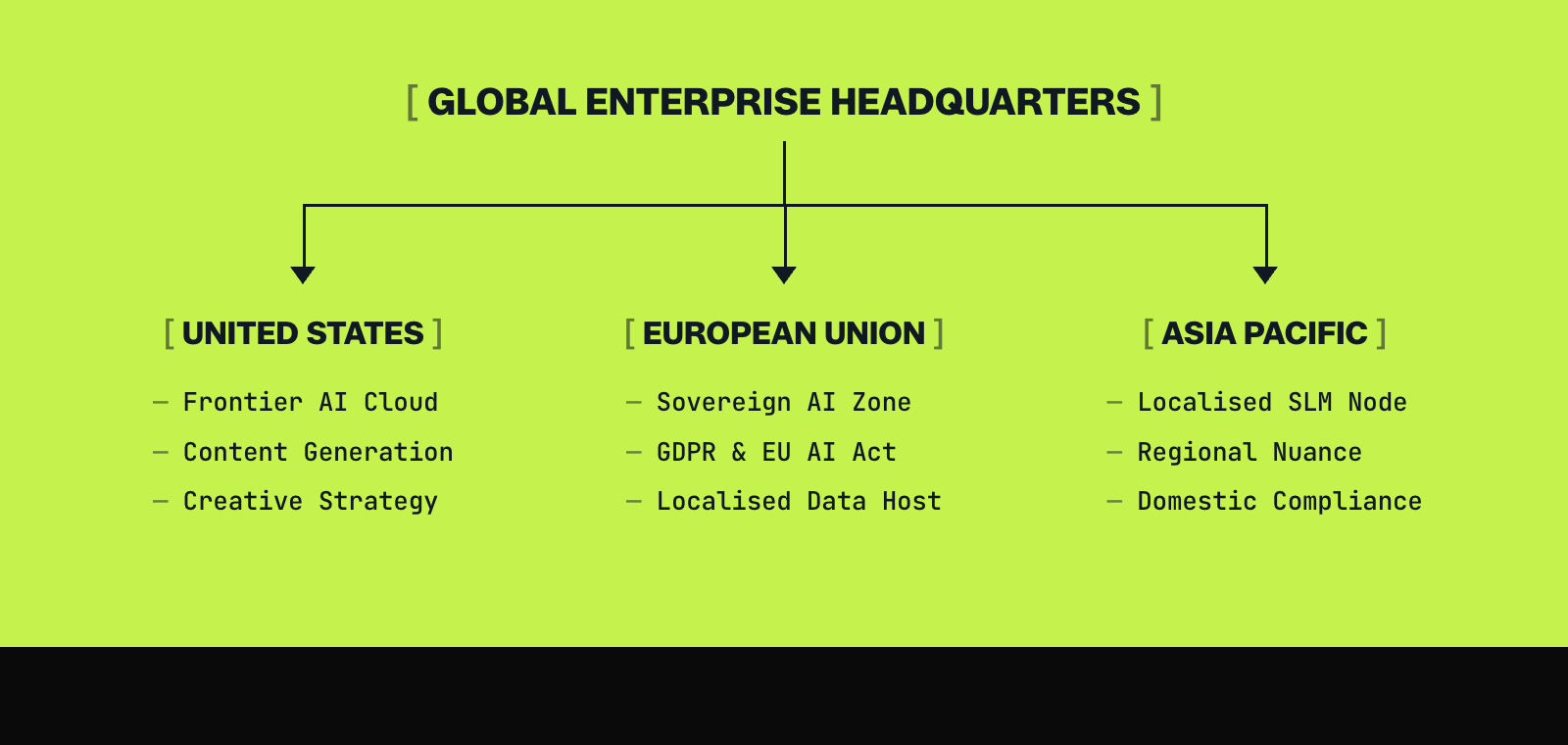
The Global Strategy Matrix
To maintain compliance and operational efficiency across a divided digital landscape, forward-thinking organizations are mapping their workflows to a split architecture:
| Operational Market | Regulatory Driver | Model Strategy | Primary Use Case |
|---|---|---|---|
| United States | Baseline Data Privacy (CCPA) | Frontier AI (Centralised Cloud) | Creative strategy, open-ended research, heavy codebase development. |
| European Union | EU AI Act & Strict GDPR Enforcement | Sovereign Cloud (Isolated Regional Instances) | Localised customer experience, regional lead scoring, regulated HR tech. |
| Asia-Pacific / MEA | National Tech Independence & Localised Privacy Laws | Domestic LLMs / Small Language Models (SLMs) | Culturally native customer support, regional B2B contract parsing. |
3. The Cross-Border Action Plan for RevOps and CMOs
If you want to future-proof your tech stack against this fracturing of global software, these adjustments should be considered:
Step 1: Adopt Multi-LLM Orchestration
Stop hard-coding your internal business tools or marketing pipelines into a single global AI API. Work with your engineering team to build an abstraction layer—an internal “switchboard”—that allows your software stack to dynamically swap out the underlying AI engine depending on the user’s physical geographic location or data profile.
Step 2: Enforce Local Platform Regionalisation
When evaluating global enterprise SaaS vendors, look beyond their front-facing features. Demand that they offer true platform regionalisation. Follow the blueprint of companies such as Adobe, which now provides dedicated digital sovereignty options within its Experience Manager platform, allowing heavily regulated sectors to host and run tools inside explicit, cleared regional cloud zones.
Step 3: Pivot to Well-Tuned Small Language Models (SLMs)
The belief that “bigger is always better” in AI is an outdated concept. For highly specific, localised B2B tasks like parsing regional legal documents or sorting market-specific lead data, a well-tuned Small Language Model (such as an 8-billion parameter localised variant) running on your own infrastructure can easily outperform a massive 175-billion parameter public cloud model. SLMs require dramatically less power and memory, allowing you to run them inside secure, air-gapped regional environments with zero cross-border data leakage.
The Bottom Line
The era of a single, uniform global tech stack is possibly drawing to a close and companies should embrace The Fractured Stack.
By designing an agile, hybrid infrastructure that respects digital borders and leverages localised, sovereign intelligence, cross-border organisations could safely scale their automation without falling afoul of global geopolitical shifts.