Someone once showed me their Slack notifications during a pipeline review. Forty-three unread alerts from their intent platform, all from one morning. One was a genuine buying signal: a target account’s CFO had visited the pricing page twice in three days. The other forty-two were noise (someone from a fifteen-person company reading a blog post once, never to be seen again).
He hadn’t opened Slack notifications properly in about six weeks. Can’t say I blame him.
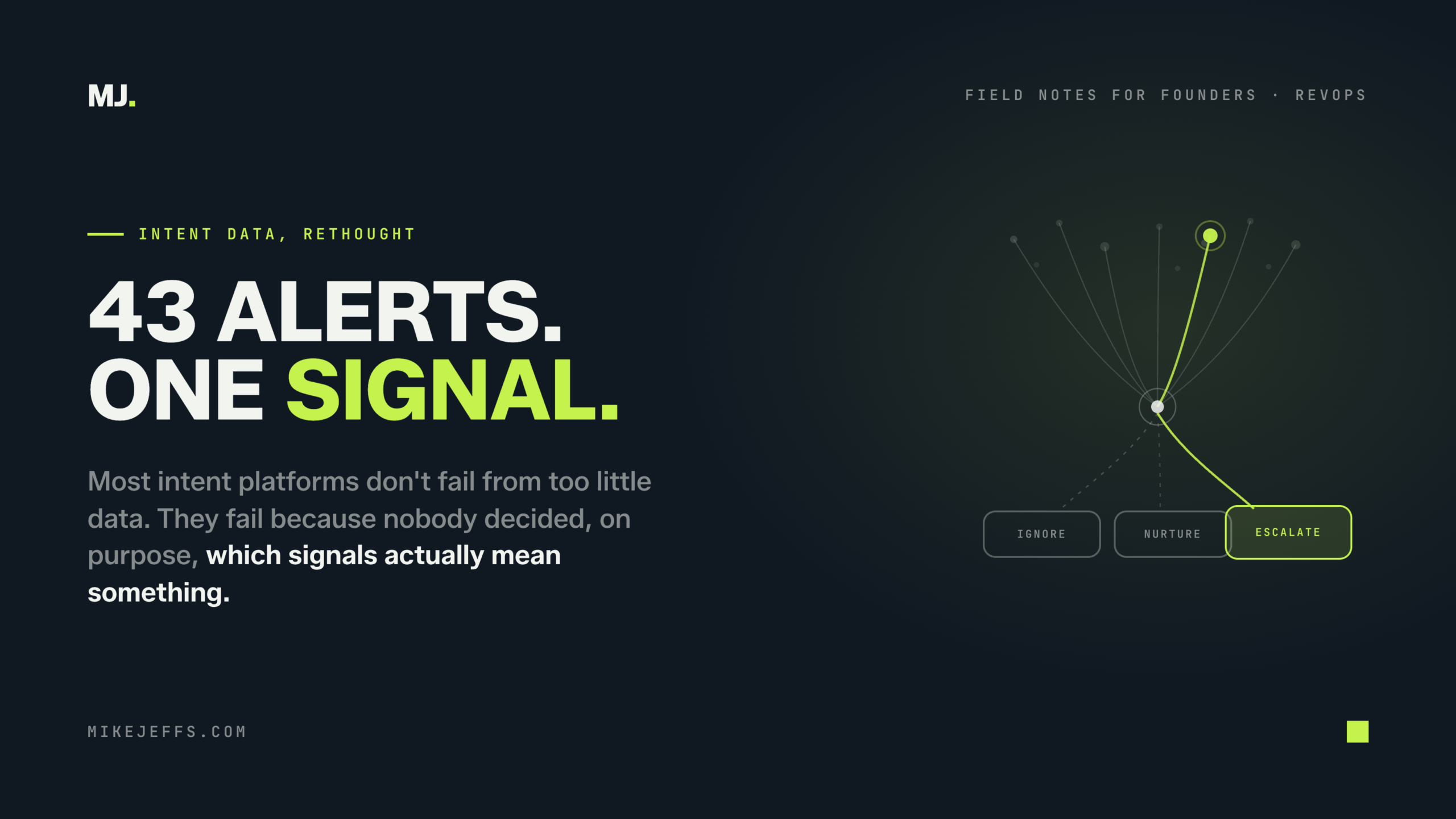
This is the bit that never makes it into the sales demo. Every RevOps platform on the market sells you the same promise: more visibility, more signals, more data on what your accounts are up to. And for the first few weeks after go-live, it genuinely feels like magic. Then the volume catches up with you, and everyone quietly starts ignoring the thing you just paid five figures for.
The vendors are answering the wrong question
Ask a platform sales rep why intent data isn’t converting, and you’ll get some version of “you need more coverage” — more first-party behavioural signals, more third-party research data, a predictive score layered on top to tell you who’s “qualified.” It’s a tidy pitch, because the fix is always another feature they happen to sell.
What it quietly skips over is that most teams I’ve worked with already have more data than they can use. Six months in, the problem was never that they couldn’t see enough. It’s that nobody had decided, on purpose, which of those signals actually meant anything for their specific sales cycle and deal size. The platform did exactly what it was built to do. It just did it for everyone, all the time, without discrimination.
Alerts don’t fail quietly. They fail loudly, then get muted
The pattern is always the same. A business switches on every alert the platform is capable of firing — pricing visits, competitor keyword research, content downloads, repeat sessions. Reps get pinged constantly, including for accounts that will never buy anything from anyone.
Within a month, they’ve done the only sensible thing available to them: they stop looking. Not selectively — completely. Which means the two or three signals a week that genuinely mattered are now buried under forty that didn’t, and nobody’s watching any of it.
That’s not a platform failure. Nobody sat down and made the call about which signals this particular business should actually act on, given how long the sales cycle runs and who’s usually in the room when a deal gets signed. Capturing everything isn’t the same as understanding anything, but that’s the assumption most implementations quietly run on.
Automation isn’t the missing piece. A decision tree is.
None of this is an argument against intent data or ABM tooling — used properly, both are genuinely good at their jobs. It’s an argument about what’s actually missing when they don’t work: not more automation, but a structure everyone on the team is working from.
Most businesses I see don’t write down what a real signal looks like for them specifically. It lives in one rep’s head, or gets reinvented every time someone new joins the team. So marketing flags an account as “high intent” because it visited three pages, sales ignores it because that’s not what high intent means to them, and both sides walk away thinking the other one doesn’t get it. Nobody’s wrong. Nobody agreed on the definition in the first place.
A CMO / Sales Leader’s job here isn’t to personally eyeball every account and make the call. It’s to build the decision tree once — this signal combination means escalate, this one means nurture, this one means ignore entirely — based on the last twenty deals won and lost, not the vendor’s default scoring model. Then it’s making sure sales, marketing, and whoever’s touching the CRM are all running the same tree, not three different versions of it. And it’s revisiting that tree every few months, because what counted as a strong signal when your ICP was different eighteen months ago probably doesn’t hold now.
Automation can execute a decision tree perfectly. It can’t build one, and it can’t tell you when it’s gone stale. That part still needs a person who’s sat close enough to the last twenty deals to know the difference.
The question worth asking before the next renewal
If your team is drowning in signals and still can’t tell you, with confidence, which five accounts to call this week, another platform isn’t going to fix that. What’s missing is a decision tree everyone’s actually working from, and someone whose job it is to build it, keep it current, and make sure sales and marketing aren’t quietly running two different versions of it.
Automation can’t do that part. It can only follow whatever tree you give it. If that gap sounds familiar, it’s probably worth a workshop before you sign off on the next renewal.