Your organisation is rapidly moving past the phase where employees use AI simply to draft a marketing email or summarise a meeting. Instead, businesses are deploying Agentic AI – autonomous digital workers capable of chaining multi-step workflows, calling external APIs, making real-time spend decisions, and altering records directly inside your CRM without human approval.
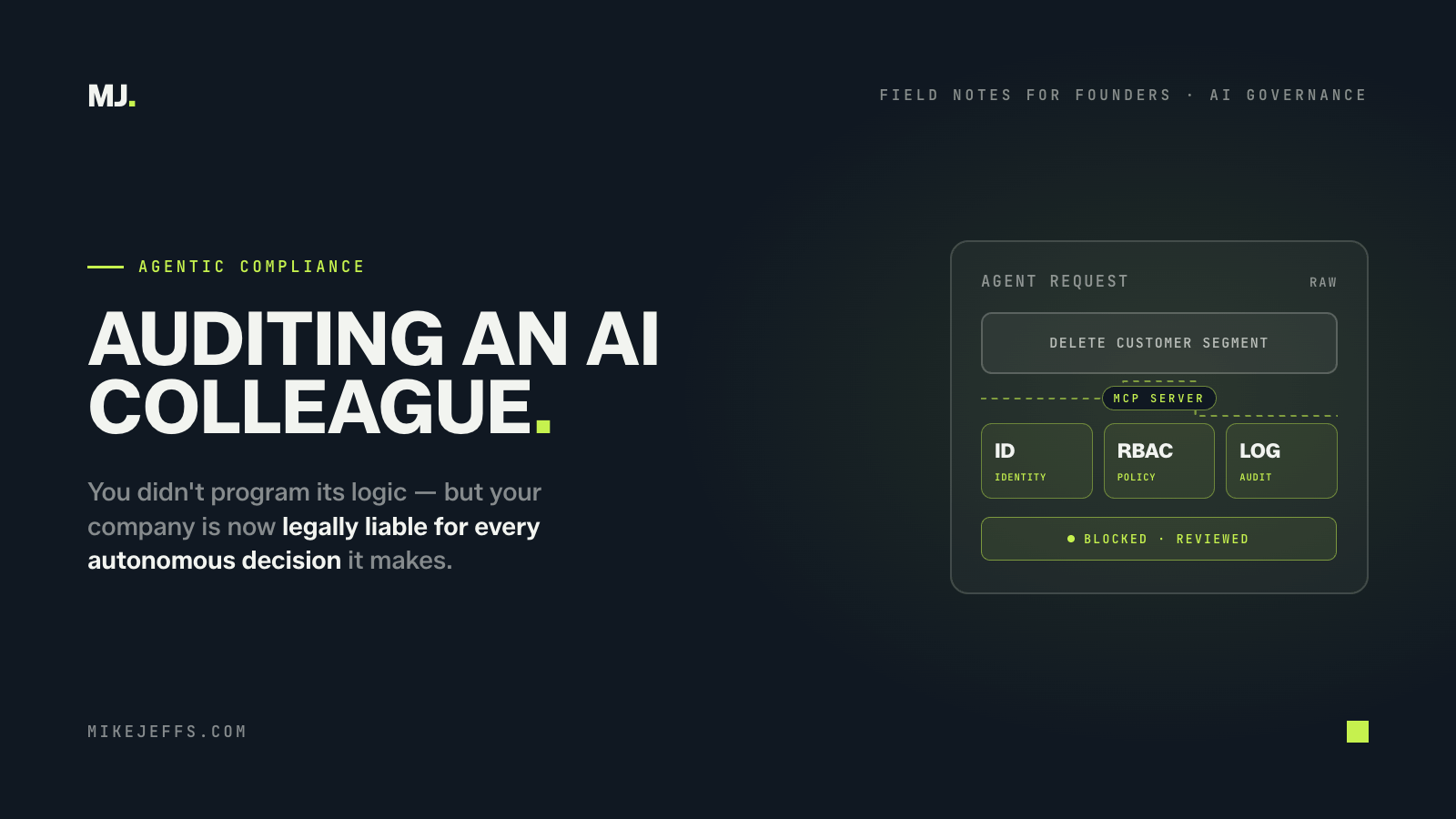
This shift delivers an unprecedented jump in operational velocity. But it also introduces a terrifying new corporate reality: You are now legally and financially liable for the autonomous decisions of an “employee” whose underlying logic you did not code, cannot fully predict, and historically could not audit.
If an autonomous customer success agent accidentally triggers a massive, unauthorised contract discount, or an HR agent inadvertently introduces a systemic bias into a hiring pipeline, you cannot fire the algorithm. The liability falls squarely on your company.
To survive this operational shift, RevOps leaders, risk officers, and executives must move away from blind trust and establish an ironclad framework for Agentic Compliance.
1. The Regulatory Hammer Has Landed
If you think agentic governance is a problem for next year’s boardroom meeting, your regulatory clock has already run out.
The global regulatory landscape has hardened significantly, and the enforcement buffer is gone.
The Transparency Mandate: As of August 2, 2026, the EU AI Act’s Article 50 transparency obligations are officially live and legally enforceable.
Under Article 50, any enterprise deploying AI systems that interact directly with natural persons, generate synthetic content, or dynamically alter public-facing text must ensure those interactions are clearly disclosed, tracked, and digitally marked. The draft guidelines explicitly state that autonomous AI agents fall squarely within this mandate. If your autonomous agent cannot reliably prove exactly how, when, and why it interacted with a customer or modified an operational path, your business faces non-compliance fines.

The problem? Traditional, closed-source frontier APIs (like standard public cloud implementations of leading LLMs) operate as complete black boxes. They are non-deterministic; they generate outputs based on shifting algorithmic weights, and providers frequently update these models behind the scenes.
If a model’s internal logic changes overnight and causes a systemic failure in your billing pipeline, your compliance team cannot retroactively audit the code to explain why the failure happened.
2. The Control Plane: Model Context Protocol (MCP)
To audit an AI colleague, you cannot rely on the protocol level of the model itself. You must implement a governed control plane between the AI model and your enterprise data.
The emerging gold standard for this architecture is the Model Context Protocol (MCP).

Originally introduced as an open standard to connect AI assistants to external tools, MCP has evolved into a critical AI data governance tool. MCP dictates a strict architectural separation: the AI model does not access your databases, CRMs, or files directly. Instead, it must ask an MCP Server to fetch data or execute actions on its behalf.
By sitting directly in the middle of the execution stream, a properly governed MCP server serves as your AI checkpoint, enforcing three non-negotiable compliance pillars:
- Granular Identity Badging: Every AI agent is assigned a unique cryptographic identity badge. The MCP server validates that the agent possesses the exact role-based access control (RBAC) permissions required for that specific request, preventing privilege escalation.
- Runtime Policy Enforcement: Even if a frontier model tells an agent to execute an action (e.g., “Delete this customer segment”), the MCP server evaluates the request against your hard-coded business rules and actively blocks the execution if it violates safety or compliance parameters.
- Per-Operation Logging: Developer-grade logging typically only records that an API call occurred. A governed enterprise MCP server logs the exact prompt, the specific user who triggered the session, the precise rows of data accessed, the timestamp, and the final outcome.
3. The Agentic Governance Matrix
Shifting your operation from passive spot-checking to continuous, proactive auditing requires updating your governance framework across three core pillars:
| Governance Pillar | The Old Method (Assistive AI) | The New Rule (Agentic AI) |
| Model Transparency | Blindly trust closed-source frontier cloud providers and untracked API updates. | Use localised, sovereign, or open-source models where model weights are frozen and completely auditable. |
| Operational Control | Grant open-ended API access with blanket system admin permissions. | Enforce structural boundaries and tool white-listing at the infrastructure layer using a governed MCP server. |
| Oversight Mechanism | Manual spot-checking of text outputs after they have been published or sent. | Real-time “Human-in-the-Loop” (HITL) approvals required for high-value financial, legal, or data mutations. |
4. The Action Plan for RevOps and Business Leaders
Building an auditable AI workforce requires immediate operational changes. Do not wait for a regulatory audit or a systemic pipeline error to build your defence. Here are some suggested steps:
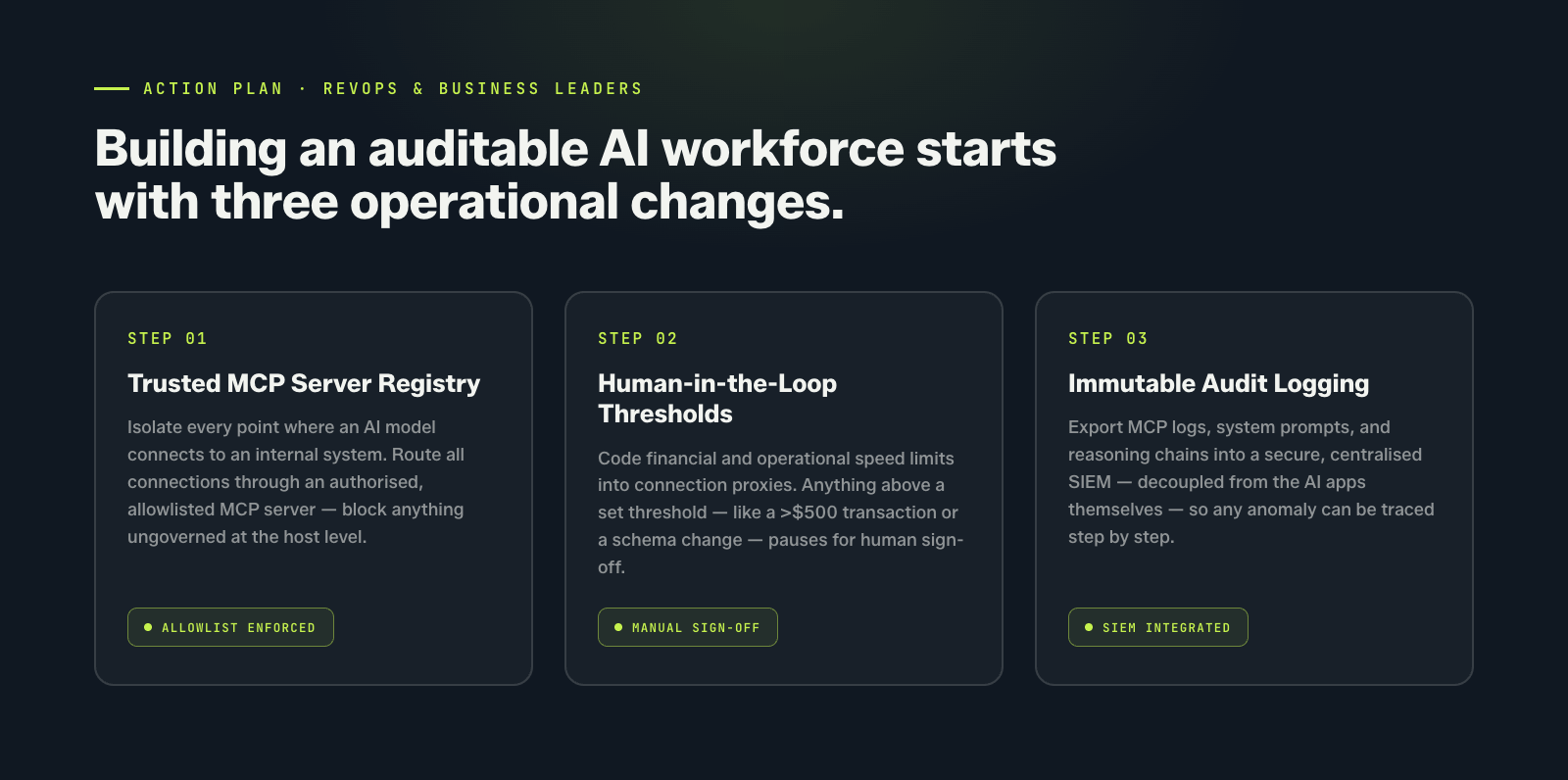
Step 1: Establish a Trusted MCP Server Registry
Audit your entire software footprint and isolate every point where an AI model connects to an internal system. Mandate that all connections run through an authorised enterprise MCP server. Create a central “allowlist” registry; any AI agent attempting to query an unlisted or un-governed data source must be automatically blocked at the host level.
Step 2: Enforce “Human-in-the-Loop” Financial Thresholds
Autonomy must have financial and operational speed limits. Code strict thresholds into your connection proxies. For example: an AI agent can autonomously draft a contract renewal or log a support ticket, but if the agent attempts to modify a financial transaction greater than $500, or alter a core schema, the system must pause execution and route a notification to a human manager for manual sign-off.
Step 3: Implement Immutable Audit Logging
Ensure your AI transaction logs are completely tamper-proof and decoupled from the AI applications themselves. Export all granular MCP server logs, system prompts, and reasoning chains directly into your secure, centralised SIEM (Security Information and Event Management) system. If an algorithm causes an operational anomaly, your engineering and legal teams must be able to debug its exact step-by-step reasoning tree just like traditional, predictable software code.
Takeaways
Autonomous AI agents are the most powerful operational force multiplier to hit the B2B landscape in decades. But true operational velocity cannot exist without total control.
The organisations that win the next decade won’t be those that unleash autonomous agents blindly; they will be the companies that treat AI agents exactly like human employees – subject to validation, verification, governed boundaries, and continuous, compliance audits.