A practical way to assess early-stage startups before the data exists
At seed stage, a lot of companies can look investable. The story might be tight. The market is big. The ambition is clear and you can get swept away with the excitement of the founder(s). What’s sometimes missing is proof and there’s always an element of risk with any seed investment because you’re making a decision with:
- limited traction
- incomplete data
- and most likely a founder who’s good at telling the story
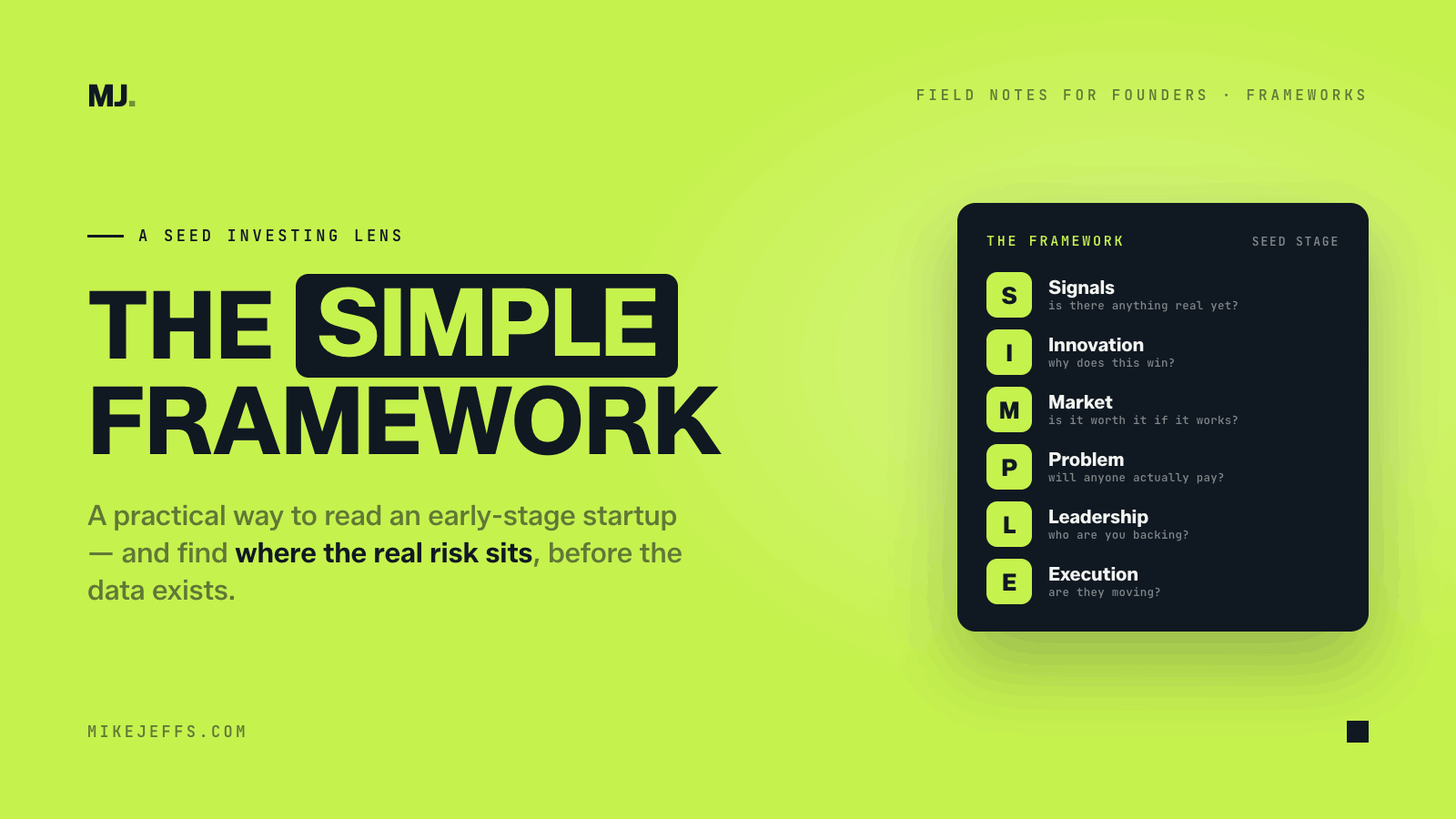
The SIMPLE framework helps see past that. It gives you a way to sanity-check what’s real, what’s assumed, and where the actual risk sits, before you commit capital.
I’ve found it most useful when you don’t have much to go on, which is exactly when it matters most.
What SIMPLE stands for
- S – Signals
- I – Innovation
- M – Market
- P – Problem
- L – Leadership
- E – Execution
You’re not scoring these like a checklist. You’re using them to build a picture of probability vs risk.
At seed stage, something will always be missing. The question is whether what’s missing is survivable.
Signals – is there anything real yet?
The business won’t have clean metrics. So you look for early signs of life:
- a handful of engaged users
- early revenue, even if small
- customers pulling the product into their workflow
- credible people choosing to get involved
You’re asking:
Is there any evidence this exists outside the pitch?
Weak signals don’t kill a deal. No signals should probably make you pause, or at least it would me.
Innovation – why does this win?
At this stage, “better product” isn’t enough. You’re looking for something that creates an edge:
- a different route to market
- a wedge into a specific customer segment
- a timing advantage (regulation, tech shift, cost curve)
The key question:
If this works, why does it work for them?
If the answer is vague, it usually is.
Market – is this worth it if it works?
Seed investing is about upside. Even if everything goes right, does this become meaningful?
You’re looking for:
- a clear starting point (beachhead)
- a path to expand beyond it
- a market that’s growing or shifting
You don’t need a fully defined TAM model.But you do need to believe there’s room to grow into something sizeable.
Problem – will anyone actually pay?
This is where a lot of early-stage ideas fall down.
The founder understands the problem.
The customer… maybe doesn’t feel it the same way.
You’re looking for problems that are:
- expensive
- time-consuming
- or operationally painful
At seed stage, intent matters more than contracts.
Are people leaning in, or just being polite?
Leadership – who are you backing?
At this stage, this is the biggest factor.
You’re not backing a finished company.
You’re backing a person (or small team) figuring it out.
Things to look for:
- do they understand the space, or are they guessing?
- can they move quickly without perfect information?
- do they attract people — hires, advisors, early believers?
You’re effectively asking:
If this needs to pivot, can they handle it?
Because it probably will.
Execution – are they moving?
Even with limited time, you can see patterns.
- Have they shipped anything?
- Have they tested assumptions?
- Have they changed direction based on what they’ve learned?
Early execution isn’t about scale. It’s about momentum and learning speed. Founders who don’t move early rarely move later.
Putting it together
You’re not looking for six green lights. You’re looking for:
- one or two strong reasons this could work
- no obvious fatal flaws
- and a team that can navigate what’s unknown
Every seed investment is a bet. The SIMPLE framework just helps you understand:
what you’re actually betting on.
How to use this in a seed round
As an angel or early investor
It helps you quickly filter opportunities and focus on the ones where risk feels intentional, not accidental.
Alongside other investors
It gives you a way to articulate concerns without defaulting to “gut feel”.
Post-investment
It’s useful for supporting founders – especially in the areas that were weakest going in.
Final thought
At seed stage, you’re not investing in certainty.
You’re investing in:
- early signs of truth
- a problem that matters
- and people who can figure the rest out
The SIMPLE framework won’t remove all risk but it helps make sure you understand where it is.